

Guandiaocnc
For a furniture factory aiming to produce high-quality, consistent, and efficient products—whether for residential, commercial, or hospitality markets—equipping the workshop with the right woodworking machines is critical. These tools not only streamline production but also ensure precision, safety, and adaptability to different wood types (e.g., solid wood, plywood, MDF). Below is a comprehensive breakdown of the **must-have woodworking machines** categorized by their core functions in the furniture manufacturing process.
## 1. Cutting & Sizing Machines: The Foundation of Material Preparation
Before any furniture piece takes shape, raw wood or wood-based panels must be cut to accurate dimensions. These machines are the first step in the production line:
- **Panel Saw (Sliding Table Saw)**
Ideal for cutting large panels (e.g., plywood, MDF, particleboard) into smaller, manageable pieces. A sliding table saw ensures straight, precise cuts even for wide materials, which is essential for cabinet sides, table tops, or wardrobe panels. Look for models with dust collection systems to maintain a clean workspace and extend blade life.
- **Circular Saw (Portable or Stationary)**
A versatile tool for cutting solid wood, lumber, or smaller panels. Stationary circular saws are better for high-volume production, while portable versions suit on-site adjustments or small-batch work (e.g., trimming legs for chairs).
- **Band Saw**
Perfect for curved cuts, irregular shapes, or resawing thick wood into thinner boards (e.g., creating slats for bed frames or decorative accents). Band saws use a continuous loop blade, making them safer and more precise than jigsaws for detailed cutting tasks.
## 2. Shaping & Profiling Machines: Adding Design & Functionality
Once materials are sized, shaping machines transform plain wood into decorative or functional components (e.g., table edges, chair rails, or cabinet doors):
- **Spindle Moulder (Router Table)**
A core machine for profiling edges, creating grooves, or adding decorative patterns (e.g., bevels, ogees, or tongue-and-groove joints). It works with both solid wood and panels, making it indispensable for customizing furniture details.
- **CNC Router**
A game-changer for modern furniture factories, especially those focused on mass production or intricate designs. CNC routers automate cutting, carving, and engraving—capable of creating complex shapes (e.g., curved chair backs, patterned cabinet fronts) with consistent precision. They also reduce labor costs and minimize material waste.
## 3. Joinery Machines: Ensuring Sturdy, Long-Lasting Connections
Strong joints are vital for furniture durability. These machines create secure connections between wood components:
- **Mortise and Tenon Machine**
The gold standard for joinery, producing mortises (holes) and tenons (protrusions) that fit together tightly—used for chairs, tables, and cabinets. Automatic models speed up production, while manual ones suit small-batch or custom work.
- **Dowel Drilling Machine**
Drills precise holes for dowels (wooden pins), which reinforce joints (e.g., in drawer boxes or cabinet frames). It ensures alignment between components, preventing wobbling or loosening over time.
- **Edge Banding Machine**
Essential for panel-based furniture (e.g., particleboard or MDF cabinets). It applies a thin strip of wood, PVC, or melamine to the exposed edges of panels, hiding raw material and enhancing aesthetics. Advanced models include trimming and buffing functions for a smooth finish.
## 4. Sanding Machines: Achieving a Smooth, Professional Finish
Sanding removes rough edges, splinters, and tool marks, preparing wood for painting, staining, or varnishing:
- **Belt Sander**
Used for heavy-duty sanding (e.g., flattening large surfaces or shaping solid wood). It works quickly but requires care to avoid over-sanding.
- **Orbital Sander (Random Orbital Sander)**
Ideal for fine sanding and finishing. Its random motion prevents swirl marks, making it perfect for table tops, chair seats, or cabinet doors. Both handheld and stationary models are available—stationary ones are better for high-volume production.
- **Wide Belt Sander**
A must for sanding large panels (e.g., plywood sheets or solid wood slabs) evenly. It uses a continuous sanding belt and adjusts to different material thicknesses, ensuring consistent results across batches.
## 5. Assembly & Finishing Auxiliary Machines
These machines support the final stages of furniture production, ensuring efficiency and quality control:
- **Clamping Machines (Bench Clamps or Pneumatic Clamps)**
Hold components together during assembly (e.g., gluing joints or attaching hardware). Pneumatic clamps are faster and more consistent than manual ones, ideal for mass production.
- **Dust Collection System**
Not a "woodworking tool" per se, but critical for factory safety and efficiency. Wood dust is a fire hazard and health risk— a high-powered dust collection system (connected to all machines) keeps the air clean, protects workers, and extends machine lifespan.
- **Finishing Spray Booths**
For applying paint, stain, or varnish evenly. Spray booths control airflow and filter overspray, ensuring a smooth, professional finish while complying with environmental regulations.
## Final Considerations for Furniture Factories
When selecting machines, factor in:
- **Production Volume**: Small factories may start with manual or semi-automatic machines, while large-scale operations need fully automated tools (e.g., CNC routers, wide belt sanders).
- **Wood Type**: Solid wood requires more heavy-duty machines (e.g., band saws, mortise machines), while panels need edge banders and CNC routers.
- **Safety Features**: All machines should include guards, emergency stops, and safety training for operators to prevent accidents. 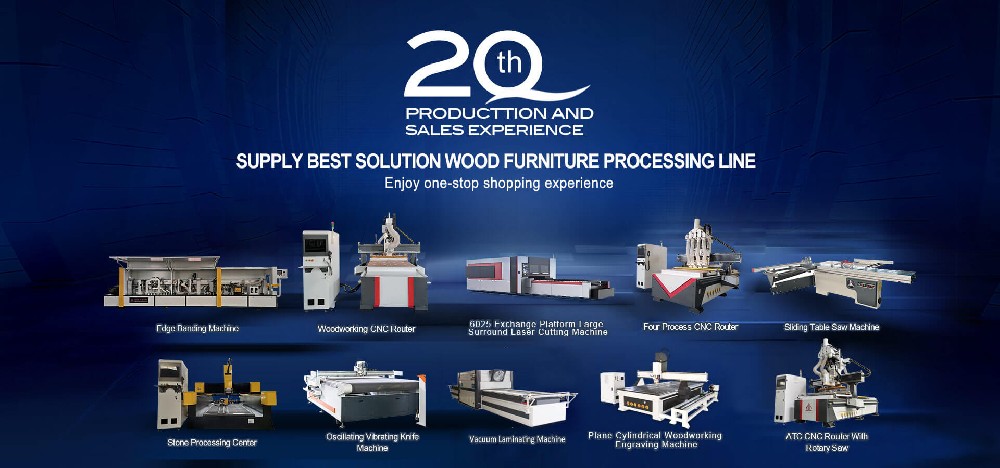

Call Us
008618668991790
E-mail: sales077@guandiaocnc.cn
Address:7-811, Rongsheng Times International Plaza, 9 Beiyuan Street, Licheng Zone, Jinan, Shandong, China
Skype: guandiaocnc
Copyright © 2024-2026 Shandong Guandiao CNC Equipment Co., Ltd. . | All Rights Reserved Technical support:Xintuweb